home |
contents
Mathematics |
previous
:
to see what's going on in
the 4th dimension |
|
Chains
of dimensions
When a line is being drawn, as the
time passes by its points jump from one position to another position of
this line. In a strange attractor,
points do not jump anymore on a line but jump on a surface.
So, we
only have to acknowledge the evidence: a strange attractor does not
represent the evolution of a line, but that of a surface.
We shall make the hypothesis, that
this mutation of the diagram along with the increase of the number of its
dimensions (a 1D line being replaced by a 2D surface) would have link with
the mutation of the represented fractal dimension: a line would represent
a fractal dimension '1', and a surface would represent a fractal dimension
'2'.
But we cannot understand the meaning
of this mutation if we only consider the functioning of a strange attractor,
and we now have to suggest a general hypothesis on the chain of all types
of dimensions. To present our hypothesis, we sum it up in a tabular form.
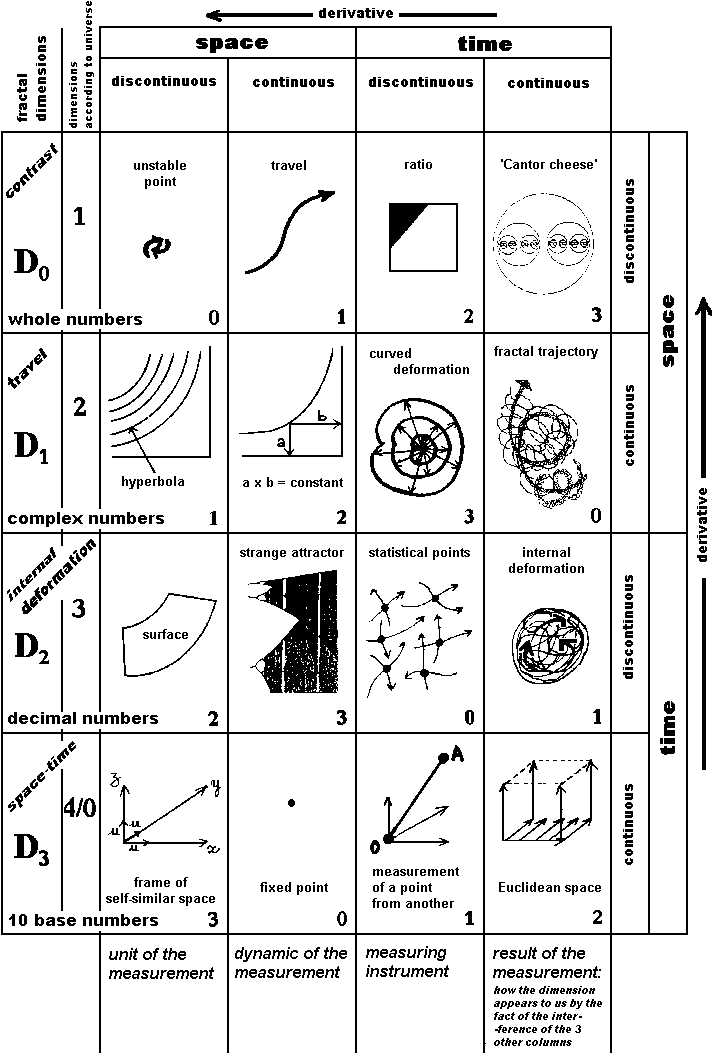
Every horizontal line corresponds
to fractal dimension, from 0 to 3.
-
in the 1st line, we
find the fractal dimension whose whole part is 0.
We said it's specially convenient for the measurement of a contrast [to
see this
again].
The first two squares of this line
show a functioning which is similar to what we described for the generating
process of whole numbers: the instability of 0, whose vibration unwind
in one go all whole numbers till infinity [to
see again
the chapter "Lets' go back from zero"].
Then, we will say this '0' fractal
dimension is that of whole numbers.
-
in the 2nd line, we
find the fractal dimension whose whole part is 1.
We said it's specially convenient for the measurement of the motion of
a body [to see this
again].
This dimension works by the simultaneous
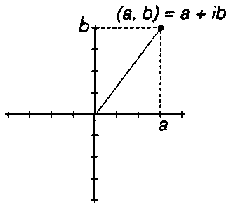
measurement of two values. As this characteristic is also that of complex
numbers, we will say this '1' fractal dimension is that of complex numbers.
|
 |
complex
numbers can be written down
in the
form a + ib
(where
i is the square root of -1)
or be represented
by a couple of numbers |
-
in the 3rd line, we
find the fractal dimension whose whole part is 2.
We said it's specially convenient for the measurement of the deformation
of a body on itself [to see this
again].
In the chapter "Let's go back from
zero" [to see this chapter
again],
we explained why decimal numbers need a '2' dimension to be produced and
recorded. Then we will say this '2' fractal dimension is that of decimal
numbers.
-
in the 4th line, we
find the fractal dimension whose whole part is 3.
Until now we did not suggest a meaning for this type of dimension.
Now, we suggest that this dimension
is that of usual coordinates in a space-time diagram.
The '3' dimension being specialized
in the interference between previous dimensions, we propose to consider
it to be the dimension that enables the combining of whole numbers with
complex numbers and with decimal numbers.
As the 10 base numbers make possible
to easily calculate numbers in all situations, we will say this '3' fractal
dimension is that of 10 base numbers.
Then the 1st line
corresponds to fractal dimensions with 0 for whole part.
As we suggest, these dimensions
are to calculate contrasts. |
- in the 1st column, we find the mathematical figure that enables
us to make the measurement [the caption describing the
function of every column is under the table]. As a contrast
can be measured by the ratio between two values, the result of this ratio
is just a number, and a number can always be represented with a point on
an axis. Then the 1st square is illustrated with a point, but as this point
is not fixed and on the opposite can endlessly move on a curve, we say
it's an 'unstable' point. It's the perpetual instability of such a point
by the effect of its internal contradictions, that would make constant
its move.
- in the 2nd column, we find the dynamic used by the measurement
instrument of the 1st square. As we just said, this dynamic is an unstable
point, then a line. We can also say: a travel.
- in the 3rd column is the way used to measure the dimension. What
we measure is the effect provoked by the deformation, and the type of the
measurement varies according to how its environment reacts to the deformation.
Here, the deformation provokes a contrast, then the measurement is the
measurement of a ratio.
- in the 4th column, we find how the measured dimension organizes
itself, that is finally, how the phenomenon appears to us in reality. Here
we give the example of the 'Cantor cheese' we can construct as a Cantor
dust [to see again
a Cantor dust], starting with a ratio that we make constant
in all scales.
In every corner of every square
of the table, we put a dimension value which enables to read the table
in a diagonal order. This reading is thus crossed with the progress along
the lines and with the progress along the columns.
We note that on every diagonal,
from the left bottom to the right top, the corner dimensions are identical.
This means that diagonal progress is well balanced for the reading of all
squares when we go from the left top to the right bottom.
When we find the digit '3',
this means that we are in the square where the self-similar character of
the fractal dimension is working.
For the '0' dimension, it's then
in the 4th square that this character appears, and the Cantor cheese in
this square is coherent with this specific character.
When we find the digit '2',
this means that we are in the square where the decimal value of the fractal
dimension is working.
For the '0' dimension, it's then
in the 3rd square that this character appears. It's given by the result
of the measured ratio.
When we find the digit '1',
this means that we are in the square where the complex function of the
fractal dimension is working.
Here it's not very 'complex', for
it's only a line that we find in the 2rd square.
When we find the digit '0',
this means that we are in the square where the whole value of the fractal
dimension is working.
Here we find it in the 1st square,
with a point that is not even stabilized. Digit 0 for this square seems
appropriate. |
The 2nd line
corresponds to fractal dimensions with 1 for whole part.
These dimensions are specially convenient
to calculate the movements. |
- in its 1st square we find the state of 'what is used to make the
measurement': they are hyperbolic curves. The characteristic of a hyperbola
is that for all its points the product of the abscissa with the ordinate
is constant. Gauss, who gave complex numbers the presentation still used
by mathematicians, also showed that complex numbers are connected with
the hyperbolic curvature of a space. These works led right to the notion
of curvature of space by masses proposed by Einstein, whose calculation
precisely uses complex numbers. It occurs that the diagonal reading of
the table, as well as the reading along the lines, corresponds in this
square with the dimension of complex numbers.
- the dynamic we find in the 2nd square comes from what we just
said about the particularity of a hyperbolic curve: what is here constant
is not an isolated value but the product of two coordinates, one as an
abscissa and the other as an ordinate. The dynamic of this dimension is
then the dynamic of continuous coordination of two '0' dimensions. The
decimal value of the '1' dimension will vary according to the relative
size of these two '0' dimensions.
- in the 3rd square we find the way of the synchronization in all
scales (diagonal reading) and how the dimension works (reading by columns).
The dimension works by a movement impulse in all directions, which we represent
by an infinite number of vectors toward all possible directions, as we
suggested before [to see
where we suggested this representation]. The specific shape
of every 'bunch of vectors' is given by the decimal value in the previous
square, and the self-similar dimension is given by the similarity of the
shape of this 'bunch of vector' in all scales.
- in the 4th square we find the way the dimension appears to us
by the effect of the interference of its first 3 aspects: it appears as
a travel, as a move. In space, a move corresponds to a whole dimension
'1'. According to the diagonal reading of the table, this square has to
tell us the value of the whole value of the dimension: it's what we do
find.
The 3rd line
corresponds to fractal dimensions with 2 for whole part.
These dimensions are specially convenient
for the measurement of internal deformations. |
- in its 1st square we find the state of 'what is used to make the
measurement': they are surfaces as we saw in our analysis of strange attractors
[to
see this
again]. According to the diagonal reading this square has to
bring the decimal value of the dimension: it's the curvature of this surface
that bears this value. Then, for fractal dimension '0', this decimal value
was made with only one value, for the fractal dimension '1' the decimal
value was made by the combination of two values, and for fractal dimension
'2' we see now this decimal value need the combination of 3 values: the
two dimensions needed to make a surface, plus the value of the deformation
of this surface.
| We can understand as follows
that the unit of measurement of this dimension is a surface:
We have to measure the deformation
of a body on itself, and this needs that all the points of the body permanently
coordinate together to exchange their respective places. In effect, during
all the deformation two points must never occupy the same place, for this
would let empty places, holes in the deserted areas, and would make excessive
density in the over-occupied areas.
Then, every point follows its one
way, what corresponds to a '1' dimension, and is involved in the same time
in the density dimension of the body so that this density remains constant.
It happens that a density dimension is a contrast dimension, then a '0'
dimension.
Every point is then subjected
to the simultaneous effect of 2 dimensions of a different type: one is
a '1' dimension, and the other is a '0' dimension.
When a point is subjected to the
coordination of 2 similar dimensions, this dimension can be summarized
in one dimension only of '1' type as we saw for the previous line of the
table, but when a point is subjected to 2 dimensions of a different
kind, then they cannot combine and the evolution of the point has to be
simultaneously depicted by these 2 dimensions.
Two dimensions, then it makes a surface.
A '2' fractal dimension is then
used to describe the evolution of this surface. |
- in the 2nd square of this dimension, we find the dynamic of the
evolution of this surface. We saw it's a 'strange attractor', self-similar
in all scales [to see this
again]. The position of this square in the diagonal reading
of the table corresponds to the synchronization in all scales, what is
coherent with the dynamic of a strange attractor.
- in the 3rd square we find that this dimension manifests itself
by statistical values, not by continuous values. Every point is made by
the crossing of the '0' dimension and the '1' dimension which apply in
the same time to construct the surface described in the 1st square. These
crossings cannot be continuously linked one to the other, for this would
mean that these 2 dimensions '0' and '1' have found a dimension of common
coordination, what is impossible, or what would take back to the fractal
dimension of the previous line. This square has to bear the value of the
whole number of the fractal dimension: every point is the crossing of 2
separate lines, what is well corresponding to the '2' value of this dimension.
We said this dimension is used to
measure the phenomena linked to the nuclear force of coherence of matter,
for matter particles are fundamentally bodies deforming on themselves [to
see this
again].
In the 'science' section of this
site, only available in French, we explain that this characteristic also
concerns gravity [to see this
text]. Then we ask the question: why does gravity force between
two bodies can be continuously described with fractal dimensions '1', whereas
the position of an electron in an atom can only be calculated with fractal
dimension '2'?
The explanation would be as following:
In the case of gravity attraction,
we have two bodies well separated from each other, so that fractal dimension
'0' of 'density' affects symmetrically along the axis joining the center
of gravity of the two bodies.
This symmetry would be what makes
possible to neglect the effects of the density dimension.
When
two bodies only are considered, and if they are outside one for the other,
the effects of one body to the other remain symmetrical: then we can neglect
the side effects that balance one another, and we can summarize all the
produced effects with two vectors only. |
On the other hand, as soon as
there is three bodies, we find non symmetrical interferences that unable
us to summarize all the forces with single vectors passing over their center
of gravity, and that requires to keep spread out all the infinite number
of vectors used to measure every dimension in every point.
In the case of an electron in an
atom, we don't have separated particles, for the electron is inside the
proton (it's our hypothesis, described
in the French version of the site), and the dynamic of the proton and
that of the electron complement each other and profondly interpenetrate.
May be, knowing that the electron
is inside the proton, not outside and alone in vacuum, may be it could
then be possible to neutralize in the calculation the effect of the proton,
and to go back to the calculation of a fractal dimension '1'. In any case,
this is a hope about the use of this table of fractal dimensions. |
- in the 4th square, we have the way the dimension appears. What
appears is a body deforming on itself by the coordinate change of position
of all its points. In the diagonal reading of the table, this square is
that of complex dimension. I don't know well enough the mathematic of complex
numbers to find the meaning of this square.
The 4th and last
line corresponds to fractal dimensions with 3 for whole part.
These dimensions are the usual dimensions
of space-time. |
- in its 1st square we find the state of 'what is used to make
the measurement': it's a space volume. As it contains the 3 dimensions
seen in previous lines, it has to have 3 distinctive curves to correspond
to the crossing of 3 dimensions of a different kind and impossible to combine.
This square being that of the self-similarity dimension, in the diagonal
direction as well in the vertical direction of reading of the table, its
curves have to be self-similar: then they have to be straight lines, to
have the same origin, and to have the same unit of measurement.
- in the 2nd square, we have the dynamic of this 3 D frame. This
dynamic consists in the permanent repositioning of all the points at the
same place relative to the point used as the origin. The resulting absence
of movement does not result from a real absence of movement, but from the complex
coordination of the movements in the 3 directions of space, so that these
movements permanently neutralize each other. As the resulting fixity is
made by the coordination in 3 distinct dimensions, '3' is the fractal value
in this square.
- in the 3rd square, we find the complex dimension of the measurement.
The essence of this measurement is that we make it 'from one point toward
another', that is: we measure the position of every point relative to the
origin.
If we go up all the 3rd column,
we see that this measurement is made increasing every time the number of
dimensions of the 'instrument of measurement':
- in the '2'
dimension, just above, the measurement is with the crossing of two
lines,
- in the '1'
dimension, above the '2' dimension, we represent it with vectors
in all the directions of space, but the value of theses vector is finally
expressed by the surface joining all their ends,
- and in the
'0' dimension, we have to compare an entire volume to another, to
measure the ratio between them.
Then, if we go down this 3rd column,
the instrument of measurement transforms itself in the following way: volumes,
surfaces, lines, points.
The same evolution by the increase
each step of one dimension, is also present in the diagrams of the other
columns.
- in the 1st
column, that of the 'unit of the measurement', we begin with a point
in fractal dimension '1', then we have a line, then a surface, and finally
a volume.
- in the 2nd
column, that of the dynamic of the unit of measurement, we begin
with a fixed point in the '3' dimension, then we have dimension '0' and
the dynamic of a continuous travel (we know that the table indefinitely
continues by putting the previous lines to follow it), then we have dimension
'1' and the coordination of 2 dimensions that has the value of a surface,
and finally with the '2' dimension we find the strange attractor: in the
example of the dripping tap we saw that such an attractor can be made gathering
3 coordinates.
By the way, this means that
a strange attractor is a diagram that has the value of a volume, and which
elementary unit is a surface.
- the 4th
column shows how the dimension finally appears in the way of the
observed phenomenon. We also find in it a line to line progress, but this
time this progress is more abstract for we find the essence of the dimensions
'according to universe'[note:
this notion of 'dimensions according to universe' is the result of the
developments of the first part of the French book
'l'adieu au big-bang' -- 'a farewell to big-bang' from which this mathematical
site is translated. Even in the French version of the site these developments
are not in line, so that the following remarks will probably be hard to
understand. However, we have already seen the notion of theses dimensions
with the dripping tap, and you can see
this explanation again] It happens that these dimensions are
not only made with the combination of an always growing number of dimensions:
at its birth every dimension makes a true mutation that radically differentiates
it from the others. We will see that the value of fractal dimensions correspond
to the value of the 'dimensions according to universe' that 'make the same
thing', which is remarkable for every square of the table of fractal dimensions
is shifted by one dimension if we compare them to the table of the dimensions
according to universe (summerized in the left of the table).
In this 4th column:
- the fractal dimension '0' measures the density of 'things' that
appear 'going from nowhere'. Then, it measures the density of a flux flowing
without any visible cause. For example, this fractal dimension can measure
the density of a flux of energy that penetrate in our universe to form
a quasar. This energy seems to come from nowhere, for previously it was
not in our universe [to see this
in the French site].
- the fractal dimension '1' corresponds to a motion that makes a
point go all the directions of space, and possibly without ever reaching
one of its previous positions. For example, when it has the maximum value
1.99999999... this dimension measures the complete dispersion of a gas
in a room by the mean of the Brownian movement of its molecules [to
see this
again]. This fractal dimension is equivalent to the '1' dimension
according to universe, that is the dimension whose essence is to divide,
to segment, to split.
- the fractal dimension '2' corresponds to the internal deformation
of a body. It's equivalent to the '2' dimension according to universe,
the dimension that collects and compacts to allow the movement to lock
in a closed loop [to see this
in the French site].
- the fractal dimension '3' corresponds to the usual space-time.
We still have to see in its 4th square how it appears to us. |
- in this 4th
square, we find again traditional space-time.
We don't need to make innovations,
we only use the tradition: a point makes a line when moving, that makes
a plane when moving, that makes a volume when moving. In the diagonal direction,
this square corresponds to the decimal value of this dimension: this decimal
value depends on the relative speed of these 3 movements.
We remark that the space-time we
get by the construction of a line, then of a surface, then of a volume,
will not change when using another of the 3 axes to start our construction:
the order of the 3 movements that generates the volume is interchangeable.
Then, the 3 dimensions are similar, and they are similar in all scales.
In its meaning of 'dimension according to universe' [to
see above
what this expression means], the '3' dimension is also equivalent
to the interference of the first 3 dimensions.
At last
we find in the meaning of the '3' fractal dimensions, the reconciliation
of the first 3 fractal dimensions: they finally find the way to combine
together so that we cannot differentiate the 3 axis of space, that we cannot
specially give to one or to the other the '0' dimension, or the '1' dimension,
or the '2' dimension.
At the end of all these reflections,
the traditional concept of measurement of space with 3 graduated orthogonal
axis, appears to be a method within four radically different methods to
measure the phenomena: four methods that are complementary the ones for
the others, and that are all contained the ones in the others.
What we finally discover is that
a
dimension is nothing but one of the 4 ways we have to combine 4 dimensions,
nothing but one of the 4 ways we have to permute their complementary roles.
The interest of this
table could be to help find the possible 'nonprobability' measurement
of the fractal dimension '2'.
Above we rapidly gave an indication
[to
see this
again] of what could make possible reducing a '2' dimension
to a '1' dimension.
But more
generally, the idea would be to think how every dimension is the 'derivative'
of the just above dimension, and the 'primitive' of the just below dimension.
The handling of the derivatives
by Newton and Leibniz was the mathematic tool that made possible all the
development of the scientific calculation since the XVII century.
Today, we still consider that a
derivative is the instantaneous change of the direction of a curve: it
would be the limit of this change when time duration tends to zero. This
concept is effective, but it is not convenient to think that a change can
really be made in zero time: in zero time a change can only be zero.
As our hypothesis proposes that
dimensions are fundamentally only deformations, it does not have this abnormality:
we consider a travel as the coordination of 2 deformations, and we can
very well stop one of the deformation making it zero, and then measuring
the other deformation that has not to be specially zero at the same time.
In
our hypothesis we call 'derivative' of a curve, the value of one of the
deformations of a travel, when its combined dimension is zero.
The dynamic of the '2' deformation
has a 'volumetric' aspect that provokes its statistical feature, for we
cannot calculate the edge of a parallelepiped if we only know its volume.
I hope
the analysis of this table will enables somebody
to find the evolution
of the surface of one of the sides of this parallelepiped, finding by this
way the absolute length of its edges.
nom de domaine